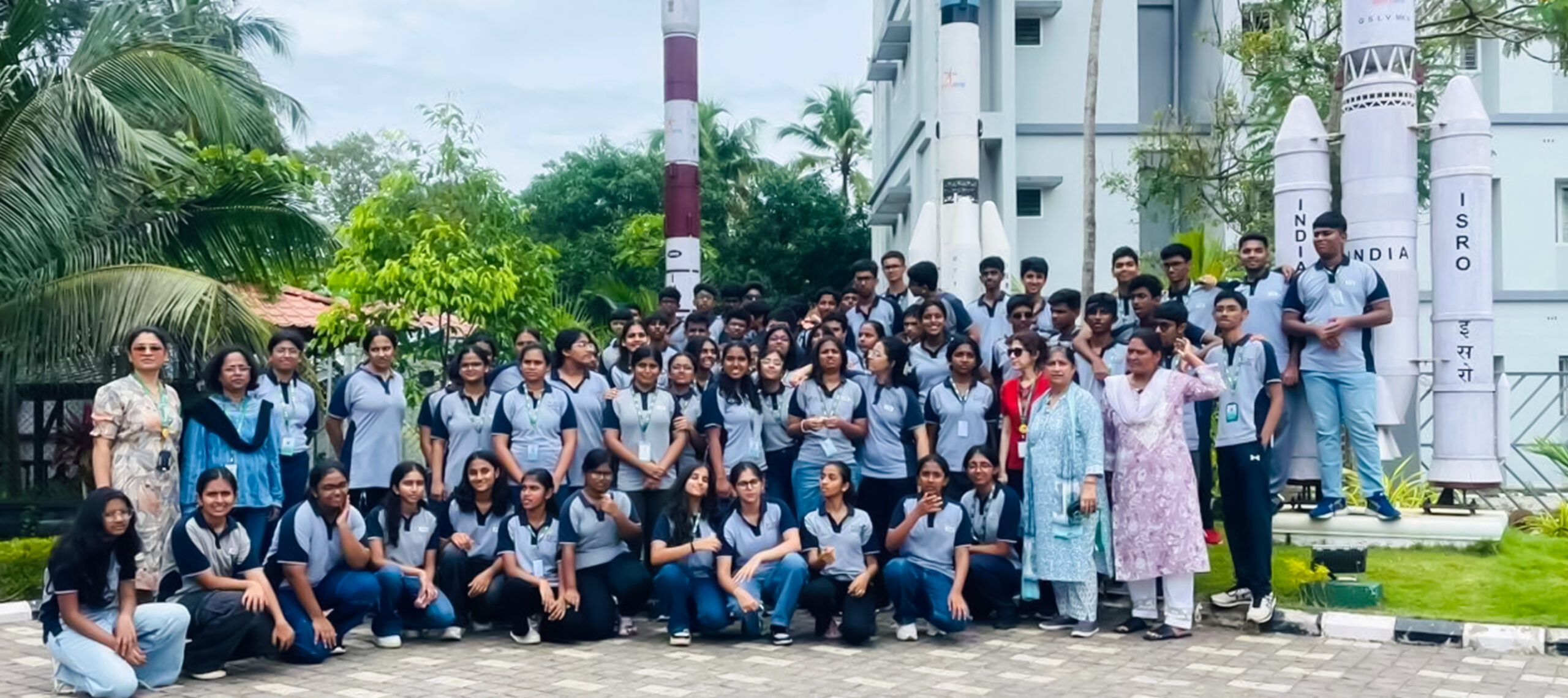
Trio World School students visit the Vikram Sarabhai Space Centre, Trivandrum to witness the live launch of the RH200 sounding rocket
68 students of Class IX & X from TRIO World School (TWS) accompanied by 5 teachers, visited the Vikram Sarabhai Space Centre at Trivandrum, India to witness the live launch of RH200 rocket. The visit took place from 9 to 21 August 2024, concluding with the launch day.
Vikram Sarabhai Space Centre (VSSC) in Thiruvananthapuram has been pioneering sounding rocket launches for scientific studies. A large number of sounding rockets have been developed and launched from Thumba Equatorial Rocket Launching Station (TERLS). ISRO has developed a series of sounding rockets called the Rohini series, with important ones being RH-200, RH-300, and RH-560. The number in the name indicates the diameter of the rocket in millimetres.
Students learned about the rocket, which has a diameter of 200 mm and a length of 3,590 mm, weighs 108 kg and carries a 12 kg chaff payload. The payload gets ejected at an altitude of 70 km, and scientific information pertaining to wind and wind velocity will be obtained from 70 km to 20 km. Balloon and surface MET sensors will provide data down to the ground surface.
During their visit to VSSC, students gained valuable insights into the intricacies of rocket launches and the critical role of weather satellites in meteorological studies. They learned about the various stages of rocket assembly, fuel systems, and the precise calculations required for a successful launch. The students were particularly fascinated by the weather satellites’ ability to collect vast amounts of data on atmospheric conditions, which is crucial for accurate weather forecasting and climate research.
This hands-on experience at VSSC underscored the importance of science education in nurturing the next generation of space scientists and engineers. By exposing students to real-world applications of physics, chemistry, and mathematics, such educational trips inspire young minds to pursue careers in STEM fields. Moreover, understanding the complexities of space technology and its impact on everyday life helps students appreciate the significance of India’s scientific advancement in addressing global challenges, from climate change to disaster management.


Leave A Comment